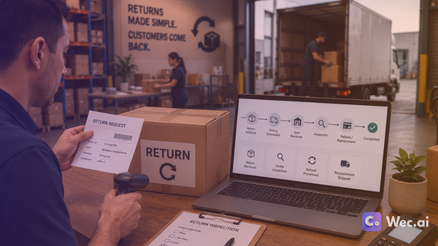
How Does Voice AI Improve Returns and Reverse Logistics Management?
Why Reverse Logistics Is Operationally Complex
Reverse logistics operations involve far more than simply processing returned items. Businesses must coordinate return approvals, pickup scheduling, carrier communication, refund processing, warehouse synchronization, and customer support simultaneously across distributed logistics networks.
As return volumes increase, these workflows create growing operational pressure for logistics teams. Customers expect faster refunds, real-time updates, flexible return options, and simplified communication throughout the return journey. At the same time, logistics providers must manage inventory movement, inspection workflows, delivery coordination, and operational visibility across multiple systems.
Many organizations still rely heavily on manual coordination between support teams, warehouses, carriers, and customers. This often leads to communication delays, failed pickups, refund uncertainty, and operational inefficiencies that negatively affect both customer experience and supply chain performance. These growing complexities are one reason businesses are increasingly adopting AI Voice Agents to automate reverse logistics communication and improve return coordination workflows at scale.
Automating Return Requests and Eligibility Verification
AI Voice Agents help businesses automate return initiation and eligibility verification through conversational workflows that simplify the customer experience. Instead of requiring customers to navigate forms or wait for live support agents, Voice AI systems can collect order information, verify purchase details, confirm return eligibility, and process return requests automatically through natural conversations.
The AI system can also gather return reasons, validate exchange requests, confirm return policies, and initiate replacement workflows while synchronizing information directly with operational systems. This conversational approach reduces repetitive support interactions while accelerating return processing across high-volume return environments.
Using Voice AI for Pickup Scheduling and Return Coordination
Coordinating reverse logistics pickups manually often creates delays and communication gaps between customers, carriers, warehouses, and logistics teams. AI Voice Agents help streamline pickup coordination by automating return scheduling workflows conversationally. Customers can confirm preferred pickup windows, update return addresses, verify availability, and receive scheduling confirmations through real-time AI interactions.
These systems can also coordinate directly with delivery partners and carrier systems to maintain synchronized pickup operations across distributed logistics networks. Voice AI additionally helps reduce operational errors by confirming return addresses, validating shipping documentation, and verifying packaging instructions before items move back through the reverse logistics network. By automating these coordination workflows, businesses improve pickup efficiency while reducing failed return attempts and manual support workload.
Creating Real-Time Visibility Across Reverse Logistics Workflows
Customers increasingly expect continuous visibility throughout the return and refund process. Delayed communication around inspections, refunds, or return status often creates frustration and additional support inquiries. AI Voice Agents help businesses maintain proactive communication across reverse logistics workflows by providing real-time return updates automatically.
Customers can receive notifications when returned items are received, inspected, approved, refunded, or processed inside warehouse operations. Voice AI systems can also proactively communicate delays, refund timelines, or additional verification requirements when necessary. These workflows improve transparency while reducing uncertainty during the return lifecycle. These proactive communication workflows follow the same principles used in real-time delivery updates with AI Voice Agents, where logistics providers keep customers continuously informed throughout the shipment lifecycle.
Reducing Support Workload in Reverse Logistics Operations
Reverse logistics operations generate large volumes of repetitive support inquiries related to return eligibility, pickup timing, refund status, and processing timelines. As return activity increases, manually handling these interactions creates operational bottlenecks across customer support and logistics coordination teams.
AI Voice Agents help reduce this workload by automating repetitive return communication workflows continuously at scale. Customers can check refund status, confirm pickup schedules, request return updates, or verify processing timelines conversationally without requiring human intervention.
Voice AI can also automate reminders related to return deadlines, shipping cutoff dates, or incomplete return steps to reduce missed return windows and customer dissatisfaction. This automation allows support teams to focus more on exception handling and complex customer issues instead of repetitive operational inquiries.
Handling Return Exceptions and Refund Workflows with Voice AI
Not all reverse logistics workflows follow standard processing paths. Damaged items, disputed returns, missing products, refund disagreements, or failed inspections often require escalation handling and operational review. AI Voice Agents help businesses manage these exception workflows more efficiently by collecting operational context automatically before escalation occurs.
The AI system can gather issue details, document customer explanations, confirm shipment information, preserve communication history, and route cases to the appropriate support or operations team when necessary. Voice AI can also automate portions of refund processing by verifying refund eligibility, confirming payment workflows, and communicating expected reimbursement timelines directly to customers. By preserving operational context throughout the escalation process, businesses reduce communication gaps while improving resolution speed across complex reverse logistics cases.
How Voice AI Improves Reverse Logistics Intelligence
AI Voice interactions generate valuable operational data across reverse logistics workflows. Businesses can analyze return reasons, pickup trends, refund delays, damaged item reports, geographic return patterns, customer dissatisfaction signals, and operational bottlenecks using data collected through conversational AI systems.
These insights help logistics providers improve warehouse planning, optimize reverse logistics workflows, reduce recurring delivery issues, and identify product or operational quality problems earlier.
As reverse logistics operations continue growing alongside eCommerce expansion, AI-driven intelligence is becoming increasingly important for improving operational efficiency, reducing costs, and maintaining customer satisfaction across large-scale return environments. As Voice AI adoption expands across logistics operations, these data-driven insights will play an increasingly important role in shaping the future of customer experience and supply chain communication.
Have questions about implementing AI Voice Agents in your logistics operations? Reach out to us at ask@wec.ai or explore our AI solutions for the logistics industry.