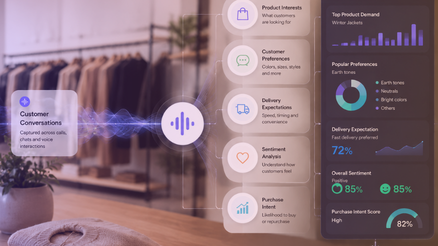
Turning Retail Customer Conversations into Actionable Data with Voice AI
Why Retail Customer Conversations Are a Valuable Source of Business Intelligence
Retailers collect vast amounts of information through transactions, loyalty programs, websites, mobile applications, and customer support systems. While these sources provide valuable insights into customer behavior, they often reveal what customers did rather than why they made those decisions.
Understanding customer motivations, expectations, frustrations, and preferences has become increasingly important as retail competition intensifies. Customers interact with brands across multiple touchpoints and continuously share feedback through product enquiries, delivery discussions, returns requests, loyalty program interactions, and customer support conversations.
These interactions often contain information that traditional retail data cannot capture. Purchase histories may show which products customers bought, but they rarely explain why one product was chosen over another. Sales reports may reveal declining demand, but they often fail to uncover the concerns influencing purchasing decisions.
As customer expectations continue to evolve, retailers that can effectively learn from customer interactions gain a significant advantage in delivering better experiences, improving operations, and identifying emerging opportunities.
How Voice AI Transforms Conversations into Structured Business Data
Historically, valuable customer insights have remained buried within call recordings, support tickets, chat logs, and agent notes. While these records contain useful information, analyzing thousands of interactions manually is difficult and time-consuming.
Voice AI helps retailers overcome this challenge by automatically processing conversations and converting unstructured interactions into organized business data.
AI Voice Agents play a key role in this process by engaging directly with customers while simultaneously capturing and structuring conversational insights that can be analyzed across the organization.
As interactions occur, Voice AI can identify customer intent, discussion topics, recurring issues, sentiment patterns, product interests, delivery concerns, service requests, and purchase signals. Information that once existed only within individual conversations becomes structured data that can be searched, categorized, analyzed, and reported across the organization.
For example, when customers contact support regarding returns, delivery issues, product availability, loyalty programs, or account questions, Voice AI can automatically classify the interaction and capture the context behind it. This allows retailers to gain visibility into customer behavior and operational performance without relying on manual reviews.
By transforming conversations into structured business data, Voice AI creates a continuous source of intelligence that supports reporting, automation, performance monitoring, and strategic decision-making.
Identifying Customer Pain Points and Operational Challenges at Scale
Many customer interactions involve recurring questions, concerns, or frustrations. While individual complaints may appear isolated, meaningful patterns often emerge when interactions are analyzed collectively.
Voice AI helps retailers identify recurring issues related to deliveries, product availability, returns, pricing, account management, customer service processes, and fulfillment operations. Instead of relying on occasional surveys or manual call reviews, retailers gain visibility into the concerns affecting large portions of their customer base.
Customer conversations also reveal operational issues before they appear in traditional reports. Recurring discussions about inventory shortages, fulfillment errors, return processing delays, or store-level issues can signal underlying operational challenges that may affect customer satisfaction.
By analyzing interactions at scale, retailers gain greater visibility into fulfillment performance, inventory management, delivery reliability, return processes, and service consistency across locations and channels. Rather than waiting for operational problems to appear in performance reports, retailers can use conversational insights to identify issues earlier and respond more proactively.
These insights become especially valuable when retailers use Voice AI to improve returns and refunds, automate order status inquiries, and streamline post-purchase support operations.
Discovering Product Trends and Purchase Intent
Customer interactions often reveal emerging product interests before those trends become visible through sales reports or market research.
Customers frequently ask questions about new products, compare alternatives, seek recommendations, request specific features, and discuss products they are considering purchasing. These interactions provide valuable signals about changing demand and purchase intent.
Voice AI helps retailers identify which products consistently generate interest, what features customers value most, and which categories are attracting increased attention.
Customers who repeatedly compare products, ask about warranties, request demonstrations, or seek clarification on specifications often reveal where they are in the buying journey. When these signals are analyzed across thousands of interactions, retailers gain a clearer understanding of both current customer interests and future demand trends.
For example, if large numbers of customers begin asking about sustainable materials, premium product features, eco-friendly packaging, or specific product categories, retailers can identify emerging demand before it becomes visible through sales data alone.
These insights support better inventory planning, merchandising strategies, product development decisions, and marketing campaigns.
Understanding Customer Sentiment and Evolving Customer Expectations
Customer sentiment plays a major role in shaping long-term retail success. However, many retailers rely heavily on surveys that capture feedback from only a small percentage of customers.
Voice AI allows retailers to analyze sentiment across thousands of real customer interactions. By evaluating conversational context, language patterns, and customer responses, businesses gain a broader understanding of how customers feel about products, services, deliveries, and overall brand experiences.
Unlike traditional feedback programs, Voice AI captures sentiment naturally during everyday interactions without requiring customers to complete additional questionnaires.
This provides ongoing visibility into customer satisfaction levels and allows retailers to identify changes in customer perception much earlier. Monitoring sentiment trends over time helps businesses evaluate operational improvements, identify emerging concerns, and better understand the customer experience.
At the same time, customer conversations frequently provide early indicators of changing expectations. Customers regularly discuss what they wish products could do, where existing services fall short, and how their shopping experiences could be improved.
Voice AI helps retailers identify recurring themes across large volumes of interactions, providing visibility into changing expectations related to product availability, delivery experiences, communication preferences, service quality, personalization, and shopping convenience.
Understanding both customer sentiment and evolving expectations allows retailers to adapt products, services, and customer experiences proactively rather than reacting after customer dissatisfaction has already developed. Retailers can also use these insights to personalize customer journeys, product recommendations, and service interactions. This approach closely aligns with how AI Voice Agents deliver personalized retail customer experiences by leveraging customer preferences and behavioral insights to create more relevant engagements.
Turning Customer Insights Into Smarter Retail Strategies
Customer insights become most valuable when they drive meaningful business decisions. While individual conversations can help resolve customer issues, analyzing interactions at scale allows retailers to uncover patterns that influence strategy across multiple departments.
Voice AI provides retailers with a clearer understanding of customer preferences, purchasing behavior, service expectations, and emerging market trends. These insights help businesses move beyond reactive decision-making and develop strategies that are more closely aligned with customer needs.
Merchandising teams can use conversational insights to identify changing product demand and prioritize inventory investments. Marketing teams can better understand customer interests, purchase drivers, and emerging trends to improve campaign effectiveness. Customer experience teams can uncover recurring frustrations and optimize customer journeys, while operations teams can identify fulfillment and delivery challenges that impact satisfaction.
Because Voice AI continuously analyzes customer interactions, retailers gain access to real-time intelligence rather than relying solely on historical reports. This allows businesses to identify opportunities faster, respond more effectively to changing customer expectations, and make better-informed decisions across the organization.
By transforming customer conversations into actionable intelligence, Voice AI helps retailers create smarter strategies that improve operational efficiency, customer satisfaction, and long-term business growth.
Building a Continuous Customer Intelligence with Voice AI
Retailers have traditionally relied on surveys, market research, and transactional reports to understand customer behavior. While these methods remain valuable, they often provide only periodic snapshots of customer activity and sentiment.
Voice AI enables retailers to build a continuous customer intelligence that learns from every interaction. Each customer conversation becomes an opportunity to capture feedback, identify trends, understand customer concerns, and monitor changing expectations in real time.
Unlike traditional feedback programs, Voice AI gathers insights naturally through everyday interactions, creating a steady stream of customer intelligence without adding friction to the customer experience.
As conversation data accumulates, retailers gain deeper visibility into customer needs, product demand, service performance, and operational challenges. These insights help teams make faster, more informed decisions across merchandising, marketing, customer experience, and operations.
As retail becomes increasingly data-driven, customer conversations are emerging as one of the most valuable sources of business intelligence. By turning conversations into structured insights, AI Voice Agents help retailers improve customer experiences, optimize operations, and build smarter, more customer-centric organizations.
Have questions about implementing AI Voice Agents in your retail business? Reach out to us at ask@wec.ai or explore our AI solutions for the retail industry to deliver better customer experiences, automate support operations, and improve customer engagement.