How AI Voice Agents Improve Retail CRM and Customer Intelligence
Why CRM Data Quality Matters in Modern Retail
Retailers collect customer data from multiple sources, including websites, mobile apps, email campaigns, social media interactions, in-store purchases, and customer support channels. This information is often stored within a Customer Relationship Management (CRM) system.
A CRM is a platform that helps businesses manage customer information, track interactions, monitor purchase history, and maintain customer relationships throughout the customer lifecycle. Retailers use CRM systems to improve customer engagement, personalize experiences, support marketing campaigns, and make more informed business decisions.
However, the value of a CRM depends entirely on the quality of the data it contains. In many retail organizations, customer records are incomplete, outdated, or fragmented across multiple systems. Valuable information gathered during customer conversations often remains locked inside call recordings, transcripts, or agent notes, making it difficult to use for business decision-making.
As customer expectations become more personalized and retail operations become increasingly data-driven, retailers need better ways to capture, organize, and utilize customer information. AI Voice Agents help address this challenge by transforming everyday customer conversations into structured and actionable CRM data. AI Voice Agents help address this challenge by transforming everyday customer conversations into structured and actionable CRM data, helping retailers transform retail customer engagement across every stage of the customer journey.
How AI Voice Agents Capture Customer Data Automatically
Every customer conversation contains valuable information about customer needs, preferences, concerns, and purchase intent. Traditionally, much of this information remained buried within call recordings or depended on support agents manually entering notes into CRM systems. This process can be time-consuming, inconsistent, and prone to human error.
AI Voice Agents help automate customer data collection by capturing and analyzing information during live conversations. As customers interact with Voice AI, the system can identify key details such as customer intent, frequently asked questions, product interests, delivery concerns, return requests, and support outcomes.
For example, a customer calling to check the status of an order provides more information than simply requesting a delivery update. The conversation may reveal preferred delivery methods, previous service issues, purchasing patterns, or future buying intentions. AI Voice Agents can automatically extract these insights and make them available within the retailer's CRM environment.
Because the information is captured directly from customer interactions, retailers can build richer customer profiles without increasing administrative workloads for support teams. This also ensures that customer records remain current as new interactions occur.
In addition to improving data accuracy, automated capture enables retailers to collect customer information at scale. Whether handling hundreds or thousands of conversations each day, Voice AI continuously generates structured customer data that can be used to improve customer service, marketing, and operational decision-making.
Enriching Customer Profiles with Voice AI
A CRM is most valuable when it provides a complete picture of each customer. Unfortunately, many customer profiles remain incomplete because valuable information gathered during support conversations is never fully recorded.
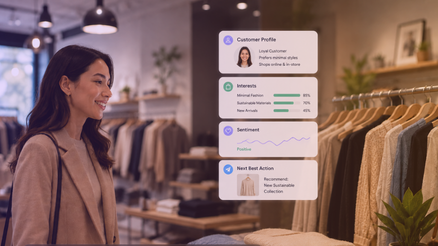
AI Voice Agents help enrich customer profiles by automatically updating CRM systems with information captured during customer interactions. This can include communication preferences, product interests, service history, delivery requirements, purchase intent signals, and previous support outcomes.
Over time, these continuous updates create more detailed and accurate customer records. Rather than relying solely on purchase history or website activity, retailers gain a broader understanding of how customers interact with the brand throughout their journey, enabling them to deliver more personalized retail customer experiences.
Enriched customer profiles also help customer service teams provide better support. When agents have access to a complete interaction history, they can respond more effectively, reduce repetitive questioning, and resolve customer issues more efficiently.
By maintaining more comprehensive customer records, retailers improve both operational efficiency and customer experience quality.
Supporting Omnichannel Customer Visibility
Modern retail customers rarely interact through a single channel. A customer may browse products online, place an order through a mobile app, contact support by phone, engage with email promotions, and participate in a loyalty program.
Managing these interactions across separate systems can make it difficult to maintain a consistent customer experience.
AI Voice Agents help support omnichannel visibility by connecting customer conversations with CRM platforms and other business systems. Information gathered during phone interactions can be combined with data from digital channels, creating a more unified customer view that helps retailers deliver a seamless omnichannel customer experience.
This enables retailers to preserve context across interactions. Customers do not need to repeatedly explain their situation when moving between channels, and support teams gain access to more complete customer histories.
A unified view of customer interactions also helps retailers identify patterns that may otherwise remain hidden within disconnected systems. By bringing together information from multiple touchpoints, Voice AI helps organizations improve customer visibility while reducing operational silos.
Improving Customer Segmentation and Personalization
Effective personalization depends on accurate customer data. Retailers cannot deliver relevant experiences if they lack visibility into customer preferences, behaviors, and purchase patterns.
AI Voice Agents help improve customer segmentation by capturing information that may not be available through traditional digital channels. For example, a customer who repeatedly enquires about athletic footwear, frequently asks about delivery options for sportswear products, and actively participates in a sports apparel loyalty program can automatically be identified as a high-interest sportswear customer. Retailers can use this information to deliver more relevant promotions, product recommendations, and loyalty offers.
As customer profiles become richer, retailers can build more precise audience segments and create more relevant engagement strategies. Marketing campaigns can be tailored to customer interests, product recommendations can become more relevant, and loyalty programs can better reflect individual customer preferences.
Personalization also extends beyond marketing. Customer service interactions become more relevant when support teams have access to a deeper understanding of customer history and needs.
By improving segmentation and personalization, retailers can increase customer engagement while delivering experiences that feel more responsive and customer centric.
How AI Voice Agents Improve Customer Intelligence in Retail
While CRM systems focus on individual customer records, customer intelligence focuses on identifying patterns and insights across large groups of customers.
AI Voice Agents generate valuable customer intelligence by analyzing thousands of customer conversations. These interactions provide insights into customer concerns, product demand, delivery issues, service expectations, and emerging trends.
For example, retailers may discover that a significant percentage of customer calls relate to delayed deliveries in a particular region. They may identify recurring product-related questions that indicate demand for additional product information. They may also uncover common return reasons that highlight quality or fulfillment issues.
Because Voice AI can process large conversation volumes automatically, retailers gain access to insights that would be difficult to identify through manual review. These insights help organizations move beyond reactive customer service and develop a deeper understanding of customer behavior, preferences, and expectations.
How AI Voice Agents Help Retailers Make Better Business Decisions
Customer intelligence becomes most valuable when it supports decision-making across the organization.
The insights generated by AI Voice Agents can help retailers improve inventory planning, marketing performance, customer service strategies, fulfillment operations, and overall business performance.
For example, frequent customer enquiries about product availability may indicate increasing demand for specific products. Recurring delivery-related complaints may reveal logistics bottlenecks that require operational improvements. Common return reasons may highlight opportunities to improve product descriptions, packaging, or fulfillment processes.
Voice AI also helps decision-makers access real customer feedback at scale. Customer intelligence generated through Voice AI can also support strategic planning. Retailers can identify emerging market trends, evaluate customer sentiment toward products and services, monitor loyalty program performance, and uncover new revenue opportunities. This allows decision-makers to respond more quickly to changing customer expectations and market conditions.
By transforming customer conversations into actionable business intelligence, AI Voice Agents help retailers make more informed decisions that improve both customer experiences and operational outcomes.
Building Smarter Retail Customer Relationships with Voice AI
Customer relationships are built on understanding. The more accurate retailers understand customer needs, preferences, and behaviors, the better they can serve them.
AI Voice Agents help retailers strengthen CRM systems by automatically capturing customer information, enriching profiles, supporting omnichannel visibility, and improving data quality. At the same time, they generate customer intelligence that helps organizations identify trends, optimize operations, and make better business decisions.
Rather than functioning solely as a customer support tool, Voice AI is becoming an important source of customer knowledge. By connecting customer conversations with CRM platforms and business intelligence processes, retailers can create a more complete understanding of their customers and deliver more personalized, efficient, and consistent experiences.
As customer expectations continue to evolve, retailers that combine AI-driven customer insights with strong CRM strategies will be better positioned to build stronger relationships, improve customer loyalty, and drive long-term business growth.
Have questions about implementing AI Voice Agents in your retail business? Reach out to us at ask@wec.ai or explore our AI solutions for the retail industry to deliver better customer experiences, automate support operations, and improve customer engagement.