How AI Voice Agents Help Retailers Reduce Customer Service Costs
Why Customer Service Costs Are Rising in Retail
Customer service has become one of the most resource-intensive functions within modern retail operations. As customer expectations continue to evolve, retailers are expected to provide fast, accurate, and convenient support throughout the entire customer journey. Shoppers now expect immediate assistance regardless of whether they are making a purchase, tracking an order, requesting a return, or seeking account information.
At the same time, retail businesses are managing increasing transaction volumes driven by eCommerce growth and omnichannel shopping behavior. Every order creates additional customer touchpoints, generating more inquiries and increasing support workloads. Retailers must therefore balance rising service expectations with growing support workloads and operational demands.
The challenge becomes even greater during periods of rapid business growth. As customer bases expand, support teams often struggle to keep pace without significant investments in hiring, training, and management. For many retailers, customer service demands continue to grow faster than operational efficiency improvements, making cost optimization a strategic priority.
The Hidden Cost of Traditional Retail Support Operations
The cost of customer support extends far beyond agent salaries. Retailers invest heavily in recruiting, onboarding, training, workforce management, quality assurance, and performance monitoring. Every new support representative requires weeks or months of preparation before becoming fully productive, creating ongoing operational overhead.
Support organizations must also manage scheduling, supervision, coaching, compliance requirements, and service-level performance. These activities consume significant management resources and contribute to the overall expense of maintaining customer service operations.
Seasonal demand introduces additional complexity. During major sales events, holiday periods, and promotional campaigns, retailers often rely on temporary staff, overtime hours, or outsourced support providers to maintain service levels. While these measures help absorb increased demand, they also increase operational expenditure and can introduce service inconsistencies that affect customer experience.
How AI Voice Agents Improve Support Efficiency and Lower Service Costs
One of the most effective ways retailers reduce customer service costs is by automating routine customer interactions. AI Voice Agents can handle large volumes of common inquiries that would otherwise require support representatives, allowing retailers to provide faster service while reducing operational pressure on customer service teams.
Instead of placing customers in queues or routing every inquiry to an agent, Voice AI can resolve routine requests through natural conversations. Customers can quickly obtain information about order status, delivery updates, return policies, store hours, account verification, loyalty programs, and product availability without waiting for assistance.
Because these inquiries are highly repetitive and information-driven, they are well suited for automation. AI Voice Agents can manage thousands of conversations simultaneously while maintaining consistent service quality. This allows retailers to reduce support workloads, shorten response times, and improve service availability without expanding support resources.
As more routine interactions are handled automatically, customer service teams can focus their attention on complex situations that require human judgment, problem-solving, or personalized support. This creates a more efficient support model while helping retailers control rising service costs.
Automating Operational Communication Beyond Customer Support
Voice AI can also automate operational conversations beyond customer support. Retailers can use AI Voice Agents to communicate with delivery personnel regarding delivery confirmations, route updates, failed delivery notifications, proof-of-delivery collection, and exception handling.
Automating these routine coordination calls reduces manual workload, improves operational efficiency, and helps retailers streamline communication between customer service teams and logistics partners.
This capability becomes increasingly valuable as order volumes grow. Rather than expanding support operations to manage both customer inquiries and logistics coordination, retailers can automate routine communication while maintaining service quality and operational control.
Many retailers begin their automation journey by focusing on routine post-purchase inquiries such as shipment tracking, delivery updates, and return status requests. Because these interactions account for a significant portion of support volume, they often deliver some of the fastest efficiency gains. This is why many retailers are implementing Voice AI to automate order status and delivery inquiries for Retailers, helping customers receive real-time updates while reducing support workloads.
Improving Operational Efficiency Across Support Teams
Beyond automating customer conversations, AI Voice Agents help improve the efficiency of internal support operations.
Customer service representatives often spend significant time performing repetitive administrative tasks such as verifying customer information, locating order records, reviewing account details, and navigating multiple systems to answer questions. While necessary, these activities reduce the amount of time available for resolving customer issues.
By integrating directly with CRM platforms, order management systems, inventory databases, and customer support tools, Voice AI can automatically retrieve relevant information during interactions. This reduces manual effort, speeds up information access, and helps streamline support workflows.
The result is a more productive support organization. Agents spend less time searching for information and more time assisting customers with higher-value interactions. Support teams can also handle inquiries more efficiently, improving resolution times and reducing operational bottlenecks.
Voice AI further supports efficiency by helping retailers improve first-contact resolution rates. When customers receive accurate information quickly and issues are addressed during the initial interaction, businesses reduce repeat contacts, escalations, and follow-up work. This improves both customer experience and overall operational performance.
Scaling Customer Support Without Increasing Headcount
Traditional support models often create a direct relationship between customer growth and staffing requirements. As interaction volumes increase, businesses typically need to hire additional agents to maintain service levels. This creates a cost structure that grows alongside customer demand.
AI Voice Agents fundamentally change this model by enabling retailers to handle significantly higher conversation volumes without proportionally increasing team size. Whether support demand rises due to business growth, marketing campaigns, or seasonal fluctuations, Voice AI can continue managing large volumes of interactions simultaneously.
This scalability provides retailers with greater flexibility and operational control. Instead of repeatedly expanding support teams, businesses can grow customer service capacity through automation while maintaining consistent service quality across increasing interaction volumes. This scalability also supports broader initiatives focused on managing after-hours customer support with AI Voice Agents, allowing retailers to extend service availability without increasing staffing requirements.
Reducing Seasonal and Peak Demand Support Costs
Retail customer service demand is rarely consistent throughout the year. Holiday shopping seasons, flash sales, promotional events, and product launches can create dramatic spikes in support inquiries within short periods of time.
Managing these surges traditionally requires additional staffing, overtime expenses, temporary workers, or outsourced support services. These solutions can be expensive and difficult to implement quickly, especially when demand fluctuates unpredictably.
AI Voice Agents help retailers manage peak demand more efficiently by providing scalable support capacity whenever inquiry volumes increase. Customers continue receiving prompt assistance without extended wait times, while retailers avoid many of the additional expenses associated with temporary workforce expansion.
This allows businesses to maintain operational stability even during their busiest periods. Voice AI also helps retailers maintain service availability outside normal operating hours without expanding support teams.
During peak periods, support teams often spend significant time coordinating with logistics providers regarding delayed shipments, failed deliveries, route updates, and delivery exceptions. AI Voice Agents can automate many of these operational conversations by communicating directly with delivery partners, reducing manual coordination while improving fulfillment efficiency.
Voice AI as a Strategic Cost Optimization Layer for Retail
Retailers are increasingly viewing AI Voice Agents as more than a customer service technology. Voice AI is becoming a strategic operational layer that improves efficiency across support functions while helping businesses maintain control over growing service demands.
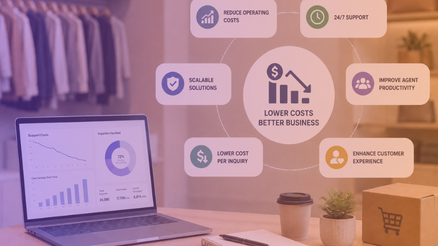
By automating repetitive interactions, increasing workforce productivity, reducing staffing pressure, and providing scalable support capacity, Voice AI creates long-term operational advantages that extend beyond immediate efficiency gains. These improvements often contribute to better customer experiences as well, supporting broader goals related to customer loyalty and retention in retail. Retailers can maintain high service standards while improving resource allocation, increasing operational effectiveness, and reducing the burden associated with growing support operations.
As competition continues to increase across the retail sector, organizations that successfully improve operational efficiency without sacrificing customer experience will be better positioned for sustainable growth.
AI Voice Agents provide a practical pathway toward achieving that balance by automating routine interactions, improving workforce productivity, and delivering scalable support capacity. Beyond improving efficiency, Voice AI helps retailers provide faster responses, maintain service consistency, and create customer support operations that can grow alongside the business.
As customer expectations continue to rise, AI-powered customer service is becoming an increasingly important component of modern retail operations.
Have questions about implementing AI Voice Agents in your retail business? Reach out to us at ask@wec.ai or explore our AI solutions for the retail industry to deliver better customer experiences, automate support operations, and improve customer engagement.