How AI Helps Coordinate Multi-Carrier Logistics Operations
Why Managing Multiple Delivery Partners Is Challenging
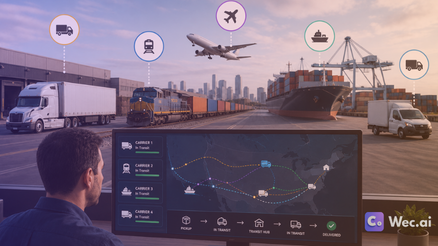
Modern logistics companies rarely rely on a single transportation provider to complete deliveries. To meet customer expectations, expand geographic coverage, and optimize transportation costs, many logistics providers work with multiple delivery partners across different stages of the shipment journey.
A shipment may move through a freight carrier, regional transportation provider, distribution center, and last-mile delivery partner before reaching the customer. While this approach improves delivery flexibility, it also creates significant communication and coordination challenges.
Each carrier often operates using different systems, tracking processes, communication workflows, and operational procedures. As shipment volume grows, logistics teams must coordinate updates, delivery exceptions, ETA changes, customer inquiries, and operational handoffs across multiple partners simultaneously. Without a centralized communication process, maintaining visibility across these distributed delivery networks becomes increasingly difficult. This is one reason logistics providers are investing in AI-powered coordination systems that can help unify communication across multiple delivery partners.
Centralizing Communication Across Carrier Networks
One of the biggest challenges in multi-carrier logistics is fragmented communication. Operations teams often spend considerable time gathering shipment information from different carriers, updating customers, coordinating warehouses, and resolving delivery issues manually.
AI Voice Agents help solve this problem by acting as a centralized communication layer across the logistics ecosystem. Instead of requiring operations teams to coordinate every interaction manually, Voice AI can automatically communicate with customers, drivers, warehouse teams, and delivery partners while keeping operational systems synchronized. This allows logistics providers to maintain consistent communication across multiple carrier networks without increasing dispatcher workload or support overhead.
Maintaining Shipment Visibility Across Multiple Delivery Partners
Maintaining accurate shipment visibility becomes significantly more difficult when deliveries move between multiple transportation providers. Customers expect real-time updates regardless of how many carriers are involved in the shipment journey. However, shipment milestones are often recorded across separate systems that do not always provide unified visibility.
AI Voice Agents help bridge these visibility gaps by continuously synchronizing shipment information across operational workflows. When delivery milestones change, delays occur, or handoffs happen between carriers, AI-powered communication systems can automatically update customers, operations teams, and other stakeholders. These capabilities work alongside real-time delivery updates using AI voice agents, helping logistics providers maintain consistent shipment transparency throughout the delivery lifecycle.
Automating Delivery Updates and Exception Handling
Delivery exceptions become more common as shipments pass through multiple carrier networks. Unexpected delays, missed pickups, weather disruptions, route changes, and failed delivery attempts can occur at any stage of the shipment journey. Coordinating responses across multiple delivery partners often creates additional operational complexity.
AI Voice Agents help automate exception management by identifying disruptions, triggering communication workflows, and delivering updates automatically. Customers can receive proactive notifications regarding delays, revised delivery windows, or operational changes without requiring manual intervention from support teams. This allows logistics providers to respond faster while maintaining communication consistency across carrier networks.
Improving Coordination Between Warehouses, Carriers, and Customers
Successful delivery operations depend on continuous coordination between warehouses, transportation providers, and customers. When communication breaks down between any of these parties, delays and operational inefficiencies quickly follow.
AI Voice Agents help streamline these workflows by facilitating real-time communication throughout the shipment journey. Warehouse teams can receive arrival confirmations, customers can receive delivery updates, and logistics operations teams can maintain visibility across active shipments without relying entirely on manual coordination. This becomes particularly valuable during high-volume delivery periods when communication demands increase significantly across the supply chain.
Reducing Manual Work for Logistics Operations Teams
Managing multiple delivery partners often creates substantial administrative workload for logistics operations teams. Dispatchers and support agents frequently spend time tracking shipment status, coordinating carrier updates, responding to customer inquiries, and resolving communication gaps between operational stakeholders.
AI Voice Agents automate many of these repetitive communication workflows. By reducing manual coordination requirements, logistics providers can improve operational efficiency while allowing teams to focus on higher-priority exceptions and strategic logistics management.
Many of these coordination efficiencies are closely connected to how logistics providers use AI Voice Agents for driver and delivery coordination. By automating communication between carriers, drivers, dispatch teams, and customers, Voice AI helps maintain operational consistency and scalability across increasingly complex logistics networks.
The Future of AI-Powered Multi-Carrier Coordination
As logistics networks become increasingly distributed, the need for centralized coordination will continue to grow. Future AI-powered logistics platforms will likely move beyond communication automation and become intelligent orchestration layers capable of coordinating carriers, warehouses, drivers, customers, and operational systems simultaneously.
Voice AI will play an important role in this evolution by helping logistics organizations maintain visibility, automate communication, and manage increasingly complex delivery ecosystems. As more shipments move across multiple delivery partners, AI-powered coordination systems will become essential for maintaining operational efficiency, delivery transparency, and customer satisfaction at scale.
Have questions about implementing AI Voice Agents in your logistics operations? Reach out to us at ask@wec.ai or explore our AI solutions for the logistics industry.