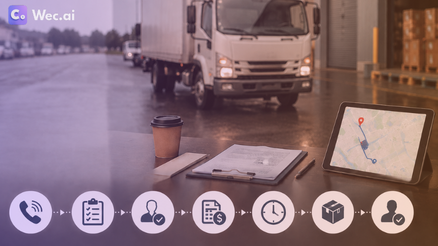
Using AI Voice Agents to Handle Driver Waiting Fees, Delays, and Delivery Issues
The Operational Impact of Driver Delays and Waiting Time
Driver delays and extended waiting time create serious operational pressure across logistics networks. A single delayed delivery can affect route planning, downstream shipment schedules, customer expectations, and overall fleet efficiency. In high-volume delivery environments, even short interruptions become costly when multiplied across hundreds of daily deliveries.
One of the most common operational challenges occurs when drivers arrive at a delivery location but cannot complete the handoff immediately. Customers may be unavailable, unloading teams may not be prepared, or access restrictions may delay entry into warehouses, apartment buildings, or commercial facilities. In freight logistics, drivers are often forced to wait beyond scheduled unloading windows, creating detention or waiting fee situations that later require validation and approval.
Many logistics providers still rely heavily on dispatch teams to coordinate these situations manually through driver calls, customer follow-ups, and operational updates. As shipment volume increases, managing large volumes of driver communication manually becomes increasingly difficult, especially during peak delivery periods and active route disruptions. These challenges are one reason logistics providers are increasingly adopting AI Voice Agents to manage high-volume driver communication workflows more efficiently across dispatch and delivery operations.
AI Voice Agents help automate these coordination workflows by acting as a real-time communication layer between drivers, dispatch teams, warehouses, and customers. Instead of routing every issue through manual operations teams, Voice AI can identify shipments, collect delivery issue details, trigger communication workflows, and update operational systems automatically. This improves response speed while reducing pressure on dispatch and support teams.
Resolving Active Delivery Issues Through AI Voice Coordination
Delivery disruptions often happen in real time while drivers are actively on route. Drivers may encounter gated communities, missing building access information, incorrect unloading locations, unavailable customers, or warehouse delays that prevent deliveries from being completed efficiently.
Traditionally, drivers must contact dispatch teams for assistance, while dispatchers manually coordinate with customers or warehouse staff to resolve the issue. In high-volume operations, these communication delays can quickly affect route schedules and increase delivery inefficiencies.
AI Voice Agents streamline this process through automated conversational coordination. When a driver encounters a delivery issue, the driver can immediately contact the AI voice system instead of waiting for dispatcher availability. The system identifies the shipment automatically, understands the issue conversationally, and begins collecting operational details in real time.
The AI can then contact customers or warehouse teams directly to request updated instructions, access information, unloading readiness confirmation, or alternative delivery guidance. If additional clarification is required, the system can continue follow-up communication automatically based on operational workflow rules. By automating these active delivery coordination workflows, logistics providers reduce route interruptions, improve delivery continuity, and minimize the amount of manual intervention required during live operations.
Automating Driver Waiting Fee and Detention Workflows
Driver waiting fees remain a major operational challenge in freight and commercial delivery environments. When drivers are forced to wait beyond scheduled unloading periods, logistics providers often need to validate detention time manually through phone calls, timestamp verification, and customer confirmations.
This process creates administrative overhead for dispatch teams while slowing reimbursement and operational reporting workflows. AI Voice Agents help automate detention and waiting fee coordination by creating structured conversational workflows for delay reporting and validation. When waiting time exceeds operational thresholds, drivers can report the issue directly to the AI voice system. The system automatically identifies the shipment, confirms arrival timing, and records operational details inside the logistics workflow. These workflows are often integrated with Transportation Management Systems (TMS), fleet management platforms, GPS tracking systems, and dispatch infrastructure to maintain synchronized operational visibility across active delivery networks.
The AI Voice Agent can also gather contextual information related to the delay, including unloading readiness, dock availability, warehouse conditions, or customer-side operational bottlenecks. In situations where additional validation is required, the system can contact warehouse teams or customers automatically to confirm unloading status and collect supporting information. Each interaction is documented automatically, creating structured operational records that simplify detention validation and reduce manual administrative workload for logistics teams.
Improving Driver and Dispatch Visibility with Automated Status Updates
Accurate shipment visibility depends heavily on drivers updating delivery milestones consistently throughout the route. In practice, drivers often forget to mark shipments as arrived, delayed, or completed while managing multiple operational tasks simultaneously. When shipment updates are missed, dispatch teams lose visibility into active deliveries and operational timelines become less reliable. This creates additional manual follow-up work for dispatch coordinators who must contact drivers directly to verify shipment status.
AI Voice Agents help improve operational visibility by monitoring shipment activity and detecting missing delivery updates automatically. If expected milestones are delayed or inactive beyond operational thresholds, the system can proactively contact the driver to verify the current shipment status. The AI Voice Agent can ask whether the delivery has been completed, delayed, rescheduled, or interrupted due to operational issues. Based on the driver’s response, shipment records and delivery timelines can be updated automatically without dispatcher involvement.
This creates more consistent operational visibility across delivery networks while reducing manual monitoring and coordination workload for dispatch teams. These coordination challenges become even more complex in multi-carrier logistics environments where shipments move across multiple transportation providers, warehouses, and regional delivery partners. In these distributed logistics networks, AI-powered coordination systems help maintain operational visibility and communication consistency across multiple carriers simultaneously.
Managing Failed Deliveries and Rescheduling Automatically
Failed deliveries create additional transportation costs, route inefficiencies, and scheduling disruptions across logistics operations. These situations often occur because customers are unavailable, receiving teams are unprepared, or delivery windows change unexpectedly during transit. Traditional failed delivery handling usually requires multiple follow-ups between drivers, dispatchers, and customers before rescheduling can happen successfully. This slows operational recovery and increases administrative workload across delivery teams.
AI Voice Agents help automate failed delivery recovery workflows by handling customer communication immediately after a failed attempt occurs. The system can contact customers automatically to confirm availability, collect updated delivery preferences, coordinate alternative delivery windows, or verify revised instructions. If escalation becomes necessary, the AI system can generate structured delivery summaries for operations teams while preserving all communication history inside the workflow.
By automating failed delivery coordination, logistics providers can reduce repeat delivery inefficiencies and improve recovery speed across active delivery operations. Businesses using proactive Voice AI coordination workflows have reported up to 40% reduction in failed deliveries through faster customer communication and automated delivery rescheduling.
Maintaining Delivery Communication Outside Business Hours
Modern delivery operations extend far beyond traditional business hours. Drivers operate across nights, weekends, and multiple time zones, while customers still expect responsive communication throughout the delivery process. Traditional dispatch models struggle to maintain continuous operational coverage because many delivery coordination workflows still depend heavily on live dispatcher availability and manual support processes.
AI Voice Agents enable continuous delivery communication by allowing drivers, warehouses, and customers to interact with automated support systems at any time. Delivery delays, access issues, rescheduling requests, and operational status updates can all be handled through conversational workflows without waiting for live support teams. Continuous Voice AI communication also helps businesses provide real-time delivery updates, improving transparency for both customers and operations teams. This becomes increasingly important as logistics providers invest in AI-powered real-time delivery communication to improve shipment visibility and reduce customer uncertainty throughout active deliveries.
This helps logistics providers maintain continuous operational responsiveness while reducing dependency on manual dispatch coordination and after-hours support workflows. As delivery networks become increasingly distributed and high-volume, continuous AI-assisted communication becomes critical for maintaining efficiency and delivery coordination at scale. Organizations implementing proactive Voice AI communication workflows have also reported up to 70% higher customer satisfaction due to faster updates, improved delivery transparency, and more responsive operational communication throughout the delivery journey.
Have questions about implementing AI Voice Agents in your logistics operations? Reach out to us at ask@wec.ai or explore our AI solutions for the logistics industry.