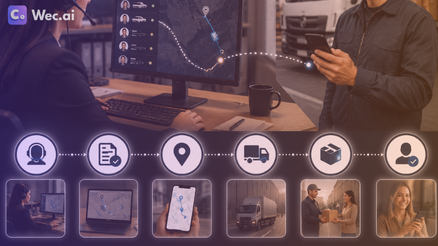
How Logistics Companies Use AI Voice Agents for Driver and Delivery Coordination
Why Driver and Delivery Coordination Becomes Difficult at Scale
Modern logistics operations rely on seamless communication between drivers, dispatch teams, warehouses, customers, and transportation systems. As delivery volumes increase, manually managing these workflows becomes increasingly challenging across large, real-time delivery networks.
Drivers often need updates on delivery instructions, route changes, customer confirmations, or operational support while actively on route. Dispatch teams must monitor deliveries, respond to exceptions, coordinate assignments, and maintain visibility across hundreds of active routes simultaneously. Even small communication delays in high-volume logistics environments can create downstream operational disruption. Missed driver updates or delayed dispatch responses affect route execution, increase waiting time, and reduce fleet productivity.
To address these challenges, logistics providers are increasingly adopting AI Voice Agents. This approach demonstrates how AI voice agents are transforming logistics customer support, creating a more responsive and scalable coordination system while reducing dependency on manual operations.
Automating Driver Dispatch and Delivery Assignment with Voice AI
AI Voice Agents help automate delivery allocation, driver availability checks, and shipment assignment workflows dynamically in real time. When new delivery requests enter the system, AI-powered coordination workflows can evaluate driver location, route capacity, shipment priority, and operational availability before assigning deliveries automatically. Drivers can receive assignment details conversationally through voice interactions without requiring manual dispatcher calls.
Voice AI can also support dynamic rerouting during active delivery operations. If traffic disruptions, urgent delivery requests, or scheduling conflicts occur, the AI system can immediately communicate updated instructions while synchronizing route information across operational systems.
These workflows integrate with Transportation Management Systems (TMS), GPS infrastructure, Electronic Logging Devices (ELD), and dispatch orchestration platforms, improving route efficiency and operational visibility. This automation works seamlessly alongside real-time delivery updates with AI voice agents, ensuring customers receive accurate and proactive shipment information as coordination occurs.
Real-Time Driver Communication During Active Deliveries
Delivery operations constantly change throughout the day. Drivers may encounter restricted access locations, updated unloading instructions, customer availability changes, or warehouse delays while actively on route.
Traditionally, resolving these situations requires multiple calls between drivers, dispatchers, warehouse teams, and customers. In large logistics environments, these manual communication loops create delays that affect delivery continuity and operational responsiveness. AI Voice Agents help streamline these workflows through real-time conversational coordination. Drivers can communicate directly with AI systems to receive updated instructions, report operational changes, confirm delivery milestones, or request support without waiting for dispatcher availability.
For example, if a customer changes delivery instructions during transit, the AI system can immediately relay updated information to the driver while simultaneously updating operational systems. These conversational workflows improve delivery coordination speed while ensuring drivers always operate using current operational information during active deliveries.
Improving Delivery Visibility with AI-Assisted Status Synchronization
Maintaining accurate shipment visibility depends heavily on timely driver updates. In practice, drivers often manage multiple operational tasks simultaneously, which can result in delayed status updates or missing delivery confirmations.
When delivery milestones are not updated consistently, dispatch teams lose operational visibility and customer communication becomes less reliable. AI Voice Agents help solve this problem by automating delivery status synchronization workflows. The system can proactively contact drivers when expected shipment milestones are delayed or inactive beyond operational thresholds.
Drivers can confirm delivery completion, delays, route interruptions, or operational exceptions conversationally without manually navigating applications or dispatcher workflows. Shipment timelines and operational systems are then updated automatically in real time. Organizations implementing proactive Voice AI communication systems have also reported up to 70% higher customer satisfaction due to faster updates and improved delivery transparency.
Reducing Dispatcher Workload Through AI-Assisted Coordination
Dispatch teams often spend large portions of their day handling repetitive coordination tasks such as checking driver status, relaying delivery instructions, managing ETA updates, and responding to operational exceptions. As shipment volume grows, these repetitive workflows create significant operational pressure and reduce dispatcher capacity for higher-priority logistics management tasks.
AI Voice Agents help reduce this workload by automating large portions of driver communication and operational coordination workflows. Instead of manually handling every delivery-related interaction, dispatch teams can rely on AI systems to manage repetitive communication automatically.
Businesses implementing AI-assisted logistics coordination workflows have reported up to 60% fewer inbound coordination calls during high-volume delivery operations. This allows dispatch teams to focus more on route optimization and escalation management rather than repetitive communication handling.
Coordinating Flexible Driver Networks and On-Demand Deliveries
Modern logistics networks increasingly rely on flexible delivery fleets, third-party transportation providers, and gig-based drivers to manage fluctuating shipment demand. Coordinating these decentralized driver networks manually can become operationally complex because driver availability and delivery capacity constantly change throughout the day.
AI Voice Agents help manage these dynamic delivery environments by automating driver communication and assignment workflows conversationally. Drivers can receive delivery opportunities, confirm assignment acceptance, update availability, or receive revised routing instructions directly through voice interactions.
These AI-assisted coordination systems become especially important in distributed multi-carrier operations where communication consistency directly affects delivery execution efficiency. Similar coordination challenges also appear in AI-powered multi-carrier logistics operations, where shipments move across multiple transportation providers and regional delivery networks simultaneously.
The Future of AI-Driven Driver and Delivery Coordination
As logistics operations continue becoming more distributed and time-sensitive, AI Voice Agents are evolving beyond simple communication tools into intelligent operational coordination systems. Future Voice AI platforms will likely support predictive dispatch coordination, automated rerouting decisions, AI-driven ETA optimization, and proactive exception handling capable of resolving disruptions before they affect delivery execution.
Instead of relying heavily on manual dispatcher intervention, logistics operations will increasingly operate through AI-assisted orchestration layers that continuously coordinate drivers, delivery workflows, shipment systems, and customer communication conversationally in real time.
In this future logistics environment, Voice AI will become a core operational infrastructure layer responsible for maintaining communication continuity, delivery synchronization, and coordination efficiency across modern supply chain networks.
Have questions about implementing AI Voice Agents in your logistics operations? Reach out to us at ask@wec.ai or explore our AI solutions for the logistics industry.