Real-Time Delivery Updates with AI Voice Agents: A Logistics Game-Changer
The Shift from Static Tracking to Real-Time Delivery Intelligence
Modern logistics systems are rapidly evolving from static, milestone-based tracking to real-time delivery intelligence. Traditional tracking systems only show updates like “order shipped,” “in transit,” or “delivered,” which are often delayed and disconnected from actual ground operations.
This creates a major visibility gap across the supply chain. Dispatch teams do not have real-time awareness of what is happening during execution, customers receive outdated information, and logistics decisions are made reactively instead of proactively. Even small delays in visibility can cascade into inefficiencies across routing, warehouse scheduling, and last-mile planning.
AI Voice Agents solve this by introducing a continuous communication layer that connects real-world delivery events with logistics systems in real time. Instead of relying on periodic updates, the system ensures that every operational change is reflected instantly, creating a live, accurate view of delivery execution across the network.
These growing expectations around live shipment visibility are also driving broader adoption of Voice AI across supply chain operations, especially in high-volume logistics environments where communication speed directly affects customer experience.
How AI Voice Agents Enable Real-Time Delivery Visibility
AI Voice Agents integrate directly with core logistics infrastructure such as Transport Management Systems (TMS), Warehouse Management Systems (WMS), GPS tracking systems, and carrier APIs. This allows them to act as a real-time data bridge between physical delivery operations and digital logistics platforms.
Whenever a shipment changes state such as leaving a warehouse, reaching a hub, entering transit, or nearing final delivery, the Voice AI system captures and syncs this event across all connected systems. These updates are structured, time-stamped, and standardized so that every platform reflects the same operational truth.
This eliminates dependency on manual driver updates or delayed backend synchronization. Logistics teams gain a single source of truth for all active shipments, enabling better coordination, improved planning accuracy, and faster response to operational changes.
Proactive ETA Updates and Dynamic Delivery Adjustments
One of the most valuable capabilities enabled by AI Voice Agents is dynamic ETA recalculation. Unlike traditional systems that generate fixed delivery estimates at dispatch, Voice AI continuously adjusts ETAs based on live operational conditions.
Factors such as traffic congestion, route deviations, warehouse delays, and system-reported disruptions are continuously evaluated to refine delivery timelines. This creates a predictive and adaptive delivery model rather than a static one.
Instead of providing outdated estimates, the system delivers continuously updated ETAs that reflect real-world conditions. This helps logistics teams manage expectations more effectively, reduce uncertainty in last-mile delivery, and improve downstream planning such as dock scheduling, fleet optimization, and delivery slot management.
Proactive Customer Communication Across the Delivery Lifecycle
A major transformation introduced by Voice AI is the shift from reactive tracking to proactive communication. Instead of customers requesting updates, the system automatically communicates key delivery events as they occur.
Customers receive timely notifications when shipments are dispatched, reach transit milestones, enter the delivery phase, or encounter delays. These updates are delivered in a conversational format, making them easier to understand and more actionable compared to static tracking messages.
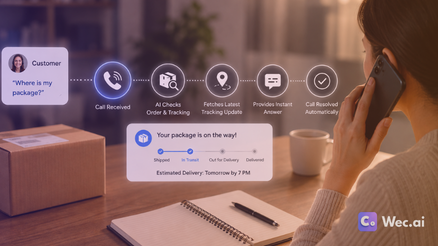
For example, instead of a simple status update, customers may receive contextual information such as delivery windows, driver proximity, or delay explanations. This reduces uncertainty, improves transparency, and minimizes unnecessary support interactions triggered by lack of visibility. Many of these repetitive delivery-status interactions eventually become where is my package? support requests, which logistics companies are increasingly automating through conversational Voice AI systems.
Improving Last-Mile Delivery Execution with Real-Time Coordination
Last-mile delivery is the most operationally sensitive stage of logistics, where delays, miscommunication, and timing mismatches frequently occur. AI Voice Agents improve this stage by ensuring continuous synchronization between drivers, customers, and logistics systems.
Drivers receive real-time updates about route changes or delivery instructions, while customers are informed about accurate delivery windows and progress. Dispatch teams gain complete visibility into active deliveries without needing to manually track each shipment. Businesses using proactive Voice AI delivery communication systems have also reported up to 60% fewer inbound support calls and significantly higher customer satisfaction due to faster updates and improved shipment transparency.
This coordination reduces failed deliveries caused by incorrect timing expectations or lack of communication. Some logistics providers also combine proactive delivery communication with AI-powered address verification workflows to improve delivery accuracy before the driver reaches the destination. It also improves route efficiency by ensuring that all stakeholders operate with the same real-time delivery information.
Building a Connected Logistics Ecosystem with Voice AI
AI Voice Agents function as a central communication layer that connects multiple logistics systems into a unified operational ecosystem. This includes drivers, warehouses, carriers, customers, and backend logistics platforms.
Every delivery event flows through this system in real time, ensuring that all stakeholders operate on synchronized data. This eliminates fragmented communication across systems and reduces delays caused by disconnected platforms. These connected communication workflows become even more important in multi-carrier logistics operations where shipments move across multiple transportation providers and regional delivery networks.
Over time, this connected ecosystem enables more advanced capabilities such as predictive logistics, automated exception handling, and intelligent route optimization. It transforms logistics operations from reactive workflows into continuously optimized systems driven by real-time intelligence.
Real-Time Delivery Updates as a Competitive Advantage
Real-time visibility is no longer a value-added feature in logistics, it has become a core expectation. Customers expect accurate, timely, and transparent updates throughout the delivery journey, and businesses that fail to provide this risk losing trust and loyalty.
AI Voice Agents convert delivery communication into a real-time intelligence system that continuously updates and informs all stakeholders. This improves operational transparency, reduces internal workload, and enhances customer confidence across the entire logistics journey.
Companies that implement real-time Voice AI systems gain a clear competitive advantage through faster communication cycles, improved operational accuracy, and a more reliable delivery experience. In a highly competitive logistics environment, real-time delivery intelligence becomes a key differentiator.
Have questions about implementing AI Voice Agents in your logistics operations? Reach out to us at ask@wec.ai or explore our AI solutions for the logistics industry.