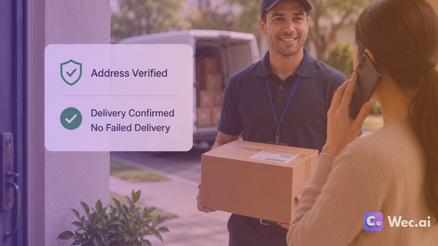
Reducing Failed Deliveries with Address Verification via Voice AI
The Rising Cost of Failed Deliveries in Last-Mile Logistics
Failed deliveries remain one of the most expensive operational problems in modern logistics. Every unsuccessful delivery attempt creates additional transportation costs, increases driver workload, affects route efficiency, and delays downstream deliveries across the network. In high-volume logistics environments, even a small percentage of failed deliveries can create significant operational disruption when multiplied across thousands of shipments daily.
For customers, failed deliveries create frustration, uncertainty, and loss of confidence in the delivery experience. For logistics providers and retailers, they lead to repeat delivery attempts, additional support interactions, fuel waste, and rising last-mile operational expenses.
The challenge becomes even more critical during peak delivery periods where route density is high and delivery timelines are compressed. A single failed stop not only impacts that shipment but can also affect route schedules, fleet productivity, and customer communication workflows throughout the day.
As logistics networks continue scaling, businesses are increasingly shifting toward proactive delivery validation workflows instead of reacting after delivery failures occur. This is where AI Voice Agents are becoming an important operational layer inside modern last-mile logistics systems.
Why Address Errors Create Delivery Failures
A large percentage of failed deliveries originate from incomplete or inaccurate delivery information. Missing apartment numbers, incorrect postal codes, gated community restrictions, unavailable unloading zones, and outdated customer contact details frequently prevent drivers from completing deliveries successfully.
In residential deliveries, drivers often struggle with missing landmarks, restricted building access, or customers who are unavailable to receive the shipment. In commercial logistics environments, warehouse unloading delays, incorrect dock assignments, and facility access limitations create additional delivery complications.
Traditionally, these issues are handled manually through dispatcher coordination and customer follow-up calls. Drivers contact dispatch teams, dispatchers contact customers, and multiple communication loops are required before the delivery can proceed. This process slows delivery execution while increasing operational workload across support and coordination teams.
The problem becomes more severe in high-volume delivery environments where dispatch teams are already managing large numbers of active routes and shipment exceptions simultaneously. Without proactive verification, many of these delivery failures are only discovered after the driver reaches the destination.
How AI Voice Agents Automate Address Verification
AI Voice Agents help logistics providers automate address verification before delivery attempts occur. Instead of relying entirely on manual validation processes, Voice AI systems can proactively contact customers through conversational workflows to confirm delivery information in real time.
When shipment systems detect incomplete, inconsistent, or potentially incorrect address details, the AI Voice Agent automatically initiates a verification call. The system can confirm apartment numbers, building access instructions, delivery landmarks, gate codes, unloading information, or alternate contact details through natural conversation.
Customers can respond conversationally without navigating forms or support queues. The AI processes the response, validates the information, and updates logistics systems automatically so dispatch teams and drivers receive corrected delivery details instantly.
Because these workflows happen before delivery execution begins, logistics teams can prevent many failed deliveries proactively instead of resolving them after operational disruption occurs. This proactive verification approach also reduces the number of delayed delivery inquiries entering customer support systems. Many logistics providers implementing automated shipment communication workflows are simultaneously using Voice AI to reduce repetitive wismo (Where is my package?) support requests by improving delivery accuracy earlier in the shipment lifecycle.
Confirming Delivery Readiness Before the Driver Arrives
Beyond address correction, AI Voice Agents also help confirm whether the customer or receiving location is operationally ready before the delivery vehicle arrives.
The system can verify customer availability, confirm unloading readiness, collect updated delivery instructions, validate access windows, or coordinate alternate receiving arrangements automatically. This becomes especially important for scheduled deliveries, commercial freight operations, gated facilities, and high-value shipments where timing coordination directly affects delivery success.
For example, if a customer is unavailable during the scheduled delivery window, the AI Voice Agent can proactively identify the issue before dispatch execution and coordinate a revised delivery timeframe automatically. Similarly, for warehouse or freight deliveries, the system can confirm dock availability and unloading readiness prior to vehicle arrival.
This proactive communication layer significantly reduces delivery interruptions caused by timing mismatches and operational misalignment between drivers and receiving locations. Organizations using AI-driven pre-delivery verification workflows have reported up to 40% reduction in failed deliveries by resolving delivery readiness issues before the final delivery attempt occurs.
Improving Last-Mile Delivery Accuracy with Voice AI
Last-mile logistics depends heavily on coordination accuracy. Even minor delivery information gaps can create route inefficiencies, missed deliveries, and unnecessary operational delays.
AI Voice Agents improve last-mile delivery execution by ensuring drivers receive verified, up-to-date, and operationally accurate delivery information before arriving at the destination. This reduces unnecessary stops, repeat visits, and manual dispatcher intervention during active delivery operations. The benefits extend beyond delivery completion alone. Better address validation improves route optimization, reduces fuel consumption, increases delivery density, and improves overall fleet productivity across delivery networks.
Voice AI also strengthens communication consistency between customers, dispatch teams, and delivery drivers. Everyone involved in the delivery process operates using synchronized and validated delivery information, which reduces confusion during high-volume operations. Many logistics providers also combine proactive address verification workflows with real-time delivery communication systems to improve customer visibility and reduce delivery uncertainty throughout the shipment journey.
Voice AI as a Preventive Layer for Logistics Operations
Traditional logistics workflows often operate reactively, where operational teams respond to delivery failures only after disruptions occur. Voice AI introduces a more preventive operational model where potential delivery problems are identified and resolved before they affect the customer experience.
By automating address validation, delivery readiness confirmation, and customer coordination workflows, AI Voice Agents reduce operational friction throughout the last-mile delivery process. Instead of increasing dispatch workload through manual follow-ups and exception management, businesses can automate large portions of delivery verification at scale.
As logistics networks become increasingly complex and delivery expectations continue rising, proactive communication and verification systems are becoming critical operational infrastructure rather than optional support tools.
In the future, Voice AI systems will likely evolve beyond simple verification workflows into predictive logistics coordination layers capable of identifying delivery risks automatically before disruptions happen. Businesses investing early in AI-driven delivery verification workflows will be better positioned to improve operational efficiency, reduce failed deliveries, and deliver more reliable customer experiences at scale.
Have questions about implementing AI Voice Agents in your logistics operations? Reach out to us at ask@wec.ai or explore our AI solutions for the logistics industry.