Omnichannel Retail Support Powered by AI Voice Agents
Why Omnichannel Support Has Become a Retail Priority
Retail customer journeys have become more connected, complex, and dynamic than ever before.
Today's customers rarely interact with a retailer through a single channel. A shopper may discover a product on social media, research it on a website, compare options through a mobile app, visit a physical store, and later contact customer support regarding an order. While customers move naturally between channels, they expect their experience to remain consistent throughout the journey.
Customers no longer view each interaction as separate. They expect retailers to recognize them across touchpoints, understand previous interactions, and provide a seamless support experience across channels.
When support systems operate independently, customers often encounter inconsistent information, disconnected conversations, and unnecessary friction. These experiences can negatively impact satisfaction, loyalty, and long-term customer relationships.
As customer expectations continue to evolve, omnichannel support has become a strategic priority for retailers seeking to deliver seamless experiences and build stronger customer loyalty.
Why Modern Retail Requires Connected Customer Journeys
Modern shopping journeys rarely follow a linear path.
Customers move between online and offline channels throughout the buying process. They may browse products online, compare alternatives through mobile apps, visit stores, contact customer support, and continue engaging with the brand long after completing a purchase.
A customer may discover a product through social media, compare prices on a retailer's website, check store availability through a mobile app, purchase online, and later contact support regarding delivery updates. While these interactions occur across different channels, customers expect the experience to feel like one continuous conversation. They expect every interaction to feel consistent regardless of how they engage with the retailer.
Retailers that fail to connect these interactions often create additional customer effort, leading to frustration and lower satisfaction levels.
Connected customer journeys help retailers maintain continuity from product discovery through post-purchase support, creating experiences that feel seamless regardless of the channel customers choose.
Why Traditional Retail Support Struggles With Omnichannel Engagement
Many retail support operations were originally designed around individual communication channels.
Customer service teams often manage phone calls, emails, chat requests, social media messages, and in-store interactions through separate systems. As a result, customer information becomes fragmented across multiple platforms.
When customers move between channels, support teams frequently lack visibility into previous interactions. Customers are often required to repeat information, explain issues multiple times, or restart conversations entirely.
This creates frustration while increasing the time required to resolve customer enquiries.
The challenge becomes even greater during post-purchase interactions. Customers seeking delivery updates, return information, refund status, loyalty support, or account assistance often engage through multiple channels before finding the information they need.
As customer engagement continues to expand across touchpoints, maintaining consistency becomes increasingly difficult for traditional support models.
How AI Voice Agents Power Omnichannel Retail Support
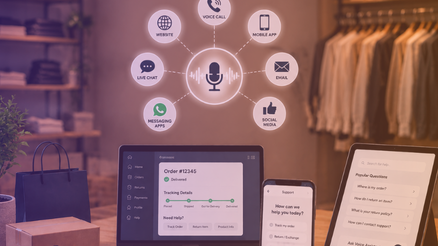
AI Voice Agents serve as an intelligent engagement layer that connects customer interactions across the retail ecosystem.
Unlike traditional automated systems that treat every conversation as a separate event, AI Voice Agents maintain context throughout the customer journey. They can access customer profiles, purchase history, delivery records, loyalty information, and previous support interactions to provide more personalized assistance.
Because Voice AI integrates with CRM platforms, order management systems, inventory databases, loyalty programs, and customer service tools, it can retrieve relevant information in real time while maintaining continuity across interactions.
This allows customers to move seamlessly between voice support, websites, mobile apps, messaging platforms, and customer service teams while receiving accurate and consistent information.
In addition to maintaining context, AI Voice Agents help retailers provide support around the clock, respond instantly to customer enquiries, and manage large volumes of interactions during peak periods. They also reduce repetitive workloads for customer service teams by automating routine requests while allowing human agents to focus on more complex customer issues. As support demand grows, retailers can scale customer engagement more efficiently without significantly increasing operational costs.
By combining automation, personalization, and real-time system access, AI Voice Agents help retailers create more connected and responsive customer experiences.
Supporting Seamless Post-Purchase Experiences Through Omnichannel Engagement
The post-purchase stage often generates the highest volume of customer support interactions in retail.
Customers regularly seek updates regarding order status, shipment progress, delivery schedules, returns, refunds, exchanges, loyalty rewards, and account information. These enquiries often occur across multiple channels depending on customer preference and urgency.
Without a unified support strategy, Customers may need to contact multiple departments or switch channels repeatedly to obtain the information they need.
AI Voice Agents help unify these interactions by providing consistent support throughout the post-purchase journey.
Customers can receive order updates, track deliveries, request return information, verify refund status, manage loyalty enquiries, and access account assistance through a seamless support experience. Because interactions remain consistent across channels, customers can continue conversations without restarting the process each time.
This helps retailers maintain stronger customer engagement long after a purchase has been completed.
Improving Omnichannel Support With RAG-Powered Information Access
One of the biggest challenges in omnichannel support is ensuring that customers receive accurate information regardless of which channel they use.
Traditional support teams often need to search multiple systems to locate inventory information, order details, delivery updates, return policies, loyalty data, and account records. This can lead to delays and inconsistencies across channels.
AI Voice Agents powered by Retrieval-Augmented Generation (RAG) address this challenge by retrieving information from connected business systems in real time.
Instead of relying solely on pre-programmed responses, the AI accesses current information from CRM platforms, order management systems, inventory databases, delivery tracking tools, knowledge bases, and customer records during the conversation.
This enables customers to receive accurate answers regarding product availability, order status, shipment progress, return eligibility, refund updates, loyalty rewards, and account information regardless of where the interaction takes place.
By providing real-time access to business information, RAG helps retailers improve support accuracy while reducing operational complexity across omnichannel environments.
Measuring the Business Impact of Omnichannel Retail Support
Retailers that successfully implement omnichannel support often experience measurable improvements across both customer experience and operational performance.
Connected customer journeys help reduce customer effort by eliminating repetitive interactions and making information easier to access. Customers receive faster responses, more consistent support, and greater visibility throughout their shopping experience.
Retailers implementing AI-powered omnichannel support strategies have reported significant operational improvements. Organizations have achieved up to a 55% reduction in customer support call volumes through automated enquiry handling while improving first-contact resolution and reducing customer effort across support channels.
These improvements often translate into faster response times, fewer duplicate enquiries, higher first-contact resolution rates, and lower customer service costs. Support teams spend less time searching for information and more time resolving customer issues, leading to greater productivity and operational efficiency.
The customer experience benefits are equally important. Customers receive more consistent support, encounter fewer service disruptions, and can resolve issues more quickly regardless of which channel they choose. This contributes to higher satisfaction levels, stronger customer retention, and increased long-term loyalty.
As customer expectations continue to rise, the ability to deliver consistent engagement across channels is becoming a significant competitive advantage for modern retailers.
The Future of Retail Customer Service Is Omnichannel and AI-Powered
Customer journeys will continue to become more complex as consumers engage with retailers across an increasing number of digital and physical touchpoints.
As expectations for convenience, speed, and personalization continue to grow, retailers must find scalable ways to maintain consistent customer experiences across every channel.
AI Voice Agents are becoming a critical component of this strategy because they help retailers connect conversations, maintain customer context, provide real-time access to information, and deliver continuous support throughout the customer journey.
Rather than operating as isolated support tools, AI Voice Agents are evolving into intelligent engagement layers that unify customer experiences across retail ecosystems.
Beyond improving support efficiency, seamless omnichannel experiences also contribute directly to customer retention. When customers can move between channels without repeating information or experiencing service disruptions, satisfaction and trust increase significantly. This is one of the reasons why many retailers are adopting AI Voice Agents to improve customer loyalty and retention through more consistent and personalized customer engagement.
Have questions about implementing AI Voice Agents in your retail business? Reach out to us at ask@wec.ai or explore our AI solutions for the retail industry to deliver better customer experiences, automate support operations, and improve customer engagement.